DBA Jyotis

DBA Jyotis

Monday, 19 December 2011

Be Born In Us @ this Christmas

"Be Born in Us" was the message that ran through the preparations that Don Bosco College, Aluva had for this Christmas. Various decorations that were done for Christmas reflected the same theme and message. Here are some photos of those decorations.


The Altar Panel


Liturgical Notice Board


Altar Decoration


Notice Board


The Crib
We would also like offer a description for the Crib that has been prepared by our brothers.
1. The whole crib represents each one of us as individuals.
2. The heart in the center in which the Baby Jesus is placed draws home the point that Jesus has to be born in each of our hearts.
3. Interestingly the heart is placed on a large Bible. This represents the fact, that the Baby Jesus who is born in our hearts must be proclaimed through the Word of God. The Gospel verse form John 1:14 announces the the fact that "The Word became flesh and lived among Us"


Thank you for Watching the photos...

Merry Christmas!

WE WISH THAT JESUS BE BORN IN YOUR HEARTS


Sunday, 21 August 2011

The Feast of The Assumption and Independence Day


Serenading Our Blessed Mother

Organizers of the Marian Serenade

 A Lamp-lit Serenade

 Brothers Play the Marian Tune

 A Violin Piece for My Mother...

 Marian Anecdote
 A Marian Symphony


A Poem to Mary

Tuesday, 26 July 2011

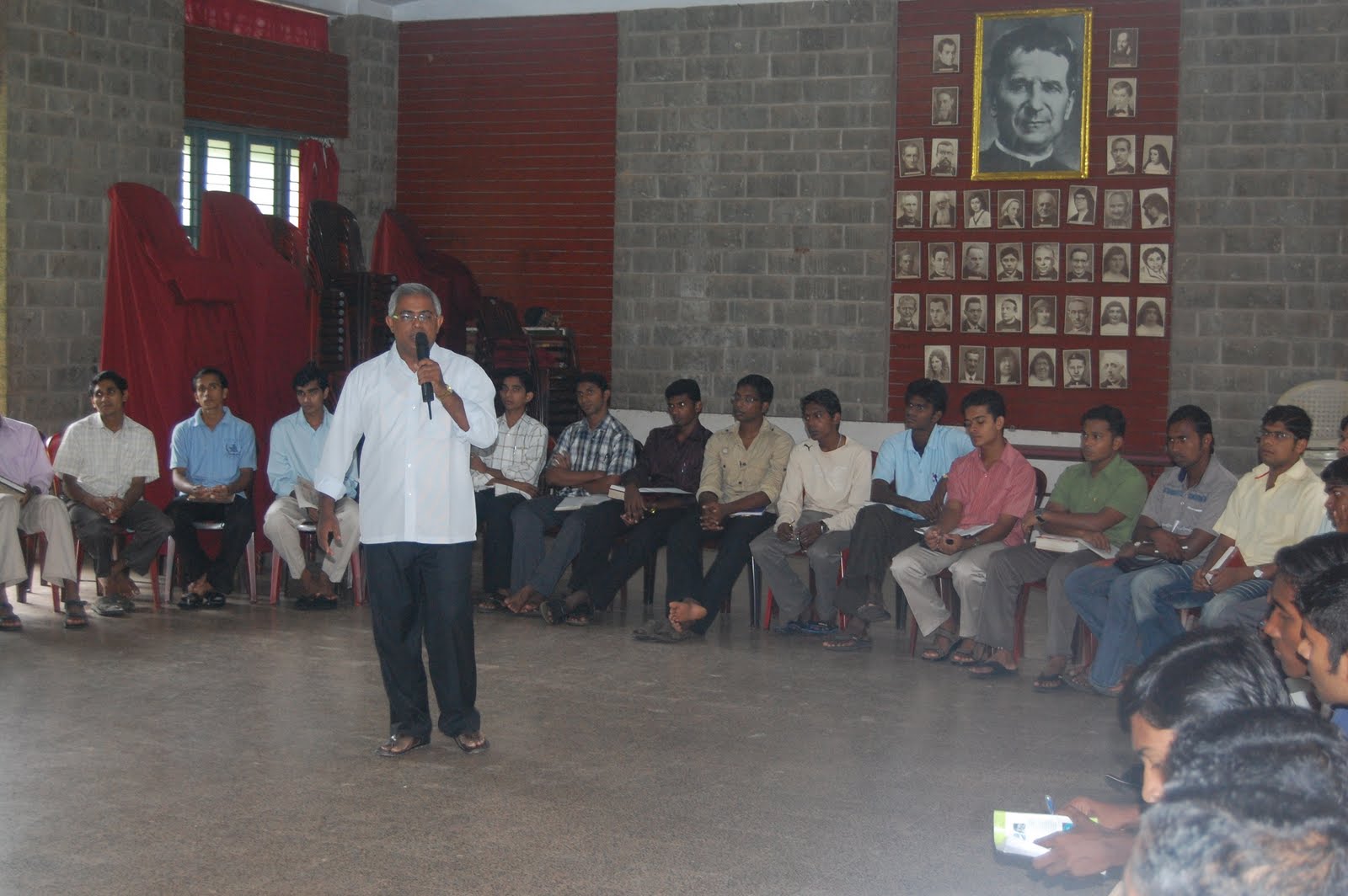
A Seminar on Youth Ministry @ Don Bosco College, Aluva


On 18th and 19th Don Bosco College, Aluva had two days of “Seminar on Youth Ministry” animated by Fr. Sivy Koroth SDB, a professor of youth ministry in Kristu Jyothi College. It was heartening to see 65 students of the college including the day scholars from other Religious Congregations participating actively in the Seminar. It was indeed an enriching and learning experience for everyone.
On the first day the animator presented the different aspects of youth ministry and made a clear distinction between youth work and youth ministry. 


He emphasized that the primary concern of youth ministry is to give Jesus to the young and the salvation of their souls. He also illustrated the present scenario in which the young people are living and cast light on their needs and aspirations. Though most of those present for the seminar opined that the young people pose new problems to the society, the problems are not absolutely out of control. They can be solved and resolved by proper guidance and accompaniment. The seminar brought to light the Church’s view on young people and the various initiatives that are being taken address the issue of today’s youth.
The second day of the seminar was marked by the presentation of various practical methods involved in youth ministry. The model that was shown was from Luke 24: 13-35 where in Jesus shows the qualities a youth minister should possess. It was highlighted a youth ministry should lead the young to have a spiritual experience in the same fashion as the two disciples on the way to Emmaus. While on the one hand the youth minister acts as a guide in moments of their difficulties and anxieties, he should also at the same time invite the young to participate in the breaking of the Word and the Bread, thereby establishing a lifelong intimacy with Jesus.
The interesting part of the Seminar was the group discussions and presentations which added colour to the event and enlivened the spirits of the participants.


Cl. Jerome Sudeep SDB

Mary Mother of God's Word


The twelfth general assembly of the synod of bishops, meeting in Vatican from 5th to 26th October, 2008 had as its theme, “the word of God in the life and mission of the church.” The basic aim of this assembly was “to renew church’s faith in the word of God.” To do so, the synod fathers invite the entire church to look to one in whom the interplay between the word and faith was brought to perfection, that is, to the Virgin Mary, “who by her ‘Yes’ to the word of the covenant and mission, perfectly fulfills the divine vocation of humanity.
Rev. Fathers and brothers, taking inspiration from the post synodal document Verbum Domini, I would like to reflect on Mary as Mother of God’s Word.
The human reality created through the word finds its most perfect image in Mary’s obedient faith. From the Annunciation to Pentecost, she appears as a woman completely open to the will of God. She is the Immaculate Conception, whom God made “full of grace” and unconditionally docile to His word. Her obedient faith shapes her life every moment before God’s plan. She is the virgin ever attentive to God’s word and lived completely attuned to the same. She treasures in her heart every event of her Son piecing them together as if in a single mosaic.
As religious and priests, in our day, we need to help the faithful to see more clearly the link between Mary of Nazareth and the faith-filled hearing of God’s word. In order to do so, first of all, we ourselves need to comprehend the relationship between our blessed mother and the word of God. Indeed, what the understanding of faith has enabled us to know about Mary is at the heart of Christian truth. The incarnation of the word cannot be conceived apart from the freedom of this young woman who by her assent decisively cooperated with the entrance of eternal into time. Mary is the image of the church in attentive listening to the word of God, which took flesh in her. Mary also symbolizes openness to God and others; an active listening which interiorizes and assimilates, one in which the word becomes a way of life.
Here I would like to mention Mary’s familiarity with the word of God which is clearly evident in the Magnificat. There we see in some sense how she identifies with the word, enters into it; in this marvelous canticle of faith, the virgin sings the praises of the Lord in His own words.
The Magnificat is a portrait of her soul, which is entirely woven from threads of Holy Scripture, threads drawn from the word of God. Here we see how completely at home Mary is with the word of God; the word of God becomes her word, and her word issues from the word of God. We also see how thoughts are attuned to the thoughts of God, how her will is one with the will of God.
Further more; in looking to the word of God, we see how God’s activity in the world always engages our freedom, because through faith divine word transforms us. Our apostolic and pastoral work will never be effective unless we learn at the school of Mary how to be shaped by the working of God within us.
Dear friends, as we contemplate in the mother of God, a life totally shaped by the word, the challenge before us in to imitate her and to realize that we too are called to enter into the mystery of faith, where by Christ comes  to dwell in our lives. St. Ambrose reminds us that every Christian believer in some way internallyconceives and gives birth to the word of God: even though there is only one mother of Christ in the flesh, in the faith Christ is the progeny of us all. Thus, what took place for Mary can daily take place in each of us, in the celebration of Sacraments. 
Cl. Gnanaprakash Dilip SDB

Thursday, 21 July 2011

Mary in the Liturgy


“In the heart of the church’s liturgy the mother of Jesus is called to mind in a way that implies veneration and which applies paschal terminology to her
            The church’s devotion to the blessed virgin is an intrinsic element of Christian worship both in the Eastern and Western churches. She is mentioned and venerated in the various elements of liturgy in the various forms of devotion and in the various feasts of the Blessed Virgin Mary during the course of the year. In the universal church Vatican II is an important landmark for the liturgical-theological understanding of Mary. Recent Magisterium of the church also gives special attention to this theme: Paul VI,s Apostolic exhortation, MARIALIS CULTUS and the encyclical of john Paul II , REDEMPTORIS MATER and the orientation and the proposals for the celebration of the Marian year 1987 are the two specifically liturgically oriented documents. I would like to share with you this Marian presence in the liturgy throughout the year.
            Starting from the annunciation scene during the advent season, we can feel the vivid presence of Mary in the Church’s liturgy through the readings, feasts and other forms of veneration including the holy mass. This reaches its pinnacle on mount Calvary as we read during the Lenten season in which Jesus gives his mother to the whole world, while hanging on the cross saying, “ This is your mother.”
            The way the Marian cult developed in the church is recognition of Mary’s place in the history of salvation. The first expressions linking Mary to liturgy are found in the Eucharist and in the rite of baptism from very early times. Marian new testament texts have been used in homilies and have been inserted as an integral part of the profession of faith. One particular text is the Magnificat.
            Probably the first liturgical text which speaks of Mary is the paschal homily of Melito of Sardisin in mid-second century. “ It is he who took flesh in the virgin.. He is the silent lamb, he is the Lamb slain, who was born of the Virgin Mary.” The identification of Mary as virgin would keep recurring in other Christian liturgical texts. Another important early liturgical witness to the place of Mary in the liturgy is the early third century apostolic tradition of Hippolytus where the name of Mary, the virgin is mentioned in the Eucharistic prayer: “You sent him from heaven into the womb of a virgin. He conceived and became flesh.” The pre-nicece period witnesses other forms of veneration to Mary such as the dedication of churches in Alexandria and Palestine
            In this regard, the impact of apocryphal writings on Marian cult deserves notice. The proto-evangelium of James recognizes Mary’s dignity as the chosen one of God. This early Christian document inspired feasts like ss. Joachim and Anne, the nativity of Mary, the presentation of Mary in the temple , he immaculate conception and Marian iconography and hymnody.


            In the fourth century the feast of Christmas was introduced which draws the attention of the believer to the Virgin Mother. The roman liturgy in the second half of the sixth century had texts, especially the lectionary and the antiphonary, that are replete with explicit Marian references. The first Marian feast in the western church was first January which dates back to the second half of the sixth century and was celebrated as ‘NATALE SANTAE MARIA’. The hymns and poems both in the west and in the east mainly by poets like, Auralius Paulinus of Nola and Sadulius have contributed much to her veneration and are still used in the Roman liturgy.
            During the seventh century more Marian feasts were introduced into the calendar of the western church. The feast of second February, originated in Jerusalem in the fourth century was celebrated as a Christological event marking the encounter of Jesus and Simeon in the temple. The feast of August 15th entered Rome in the mid-seventh century. 25th March as a feast of annunciation appeared in Rome in mid-seventh century. The feast of the nativity of Mary on 8th September was introduced in Rome by the end of the seventh century. It had it’s origination in Jerusalem.
            Coming to the eighth and the ninth centuries, we can find the establishment of the Saturday memorial of the Blessed Virgin under Alcuin. The motives behind this devotion were developed only in the 13th century: Saturday was the day ’blessed’ by the Lord and Mary is the blessed one; on Saturday God rested and Mary is the place where God rested. The feasts like the Immaculate Conception, visitation and the presentation of Mary too developed in this century.
            In the new fundamental books of Roman liturgy, Mary appears united to Christ as the work of our redemption is celebrated in the course of the liturgical year. Marian feasts of Annunciation and presentation are now the feasts of the Lord. Immaculate heart of Mary and our lady of Mt. Carmel became optional memorials and the feasts of holy name of Mary and our lady of ransom were dropped.
            In the Roman liturgical celebration, the Marian presence is a part of the living tradition of the church. The new reforms have only enriched both Marian theology and Marian devotion. So, friends, let us too contemplate on Mary as we reflect upon the annual cycle of Christ’s mysteries in the liturgy because she is joined by an inseparable bond to the saving work of her son.


Jerin Palatty SDB

Tuesday, 19 July 2011

IAS: Indian Adukala Service at DBA


Rolling and Laughing


Chapatti Making Industry


Rock and Roll


The best that I can do...


Give us today our daily  chapatti


For delicious and salty chapattis place your orders today!!!